
BIM4Housing Group A Roundtable (Dry/wet Riser, Sprinkler Systems)
MATT FORD I'm not saying I'm the world's expert, but my background is sprinklers, so I'm happy to input as required.
RICHARD FREER George, do you just want to do a bit of an update?
GEORGE STEVENSON Just to give you some background, a number of people on the call now participated in this. We were asked by the government to support an initiative called the Golden Thread Initiative and what they were asking is what information was actually needed. (shares screen). We were given responsibility for the asset and survey information and we’ve held lots of roundtable workshops and what you’re going to see in terms of the documents that we’re going to run through actually came out of that collaboration. So we have lots of people who were subject matter experts, including developers, clients and manufacturers.
The point was that these people who are competitors in many ways are actually sitting around the table sharing their knowledge. Alex is over there on the operations side as well. The result of that was that we asked the team some specific questions like what risks does the sprinkler system mitigate? What do people do to sprinkler systems to stop them from working properly? What information is needed? What methods should be employed? What level of competence is needed? And also how should product changes be recorded? So this is a standard methodology we did against 12 asset types which we’re running through yesterday and today to update them.
We’ve actually got deep dive recommendations for all of these asset types, they’ve been up on the BIM4Housing website for the last 4 years and they were all refreshed and updated in 2023. And what we’re doing this week is doing the same for all of them as well. What we’ve also done since then is added in some additional details. For example, we’ve worked with the NHS to come up with a standardised way of doing fire door inspections. And there is quite a nice document now that you can go into and the intention here is to improve people’s competency. And we’ve been doing the same also for fire dampers, fire stopping and cavity barriers.
We also need to look at things from a point of view of rather from the individual asset types, how do these things all work together as a collective? So the way in which we’re trying to do this is to give people the context because what most people do when you ask them what information do you need, they’ll say well, it depends. And it always depends on the context. So this is a simple way of just identifying the context of a fire breaking out in a kitchen, the main goal is to stop smoke from spreading into that stairwell. How do we go about doing that? The fact is that you’ve got a series of systems that work together.
So compartmentation is a system that’s made up of a number of different components parts. And all of those need to be working perfectly. You may have the best fire doors, like Harmony fire doors for example, but the problem then is if the penetration seals aren’t right then we’ve got a big problem. And then you’ve got back up things like smoke control detection and signage. So all of those things need to be able to work together. And what we’re doing at the moment, the success of the Golden Thread Initiative has been strong and we’ve got lots of people producing golden threads, but the challenge is that they’re all separate. So what we need to do is federate them.
So the information may be on that door and what product was used is great, but we need to know where it is in the building and what spaces it’s protecting, because that’s critical from the fire perspective. And we also want to make sure that if people are using a range of different software applications to maybe do inspections, that what we’re actually doing is making sure that they’re all inspecting that individual asset so that we’ve got a proper record of it. The other thing is Regulation 38 the fire & emergency file, we’re discovering that although it’s the law and people have got to provide this information and if they don’t they’re breaking the law.
We’re finding that in many cases people are signing the Regulation 38 documentation and saying that they’ve got all of the information that they need to manage the building, but actually they don’t. And the same with contractors, this has been put into Building Control to be able to address the fact that the information isn’t high enough quality. So that’s why we’re trying to raise the bar with this and make it clear that, in this particular case, the fire critical assets which is what we’re trying to cover, are actually there. One thing we’ve done is looked at this from a point of view of auditing. So we’ve got the Golden Thread Taskforce as a community, we’ve got over a hundred people that are involved in it now.
And if you’re interested in becoming part of the Golden Thread Taskforce please put ‘Golden Thread Taskforce’ in the chat and we can introduce you to some of the other people. But the principle here is that we’re trying to simplify it to make sure that we’ve got this basic information about each asset type. That’s obviously not as detailed as we’re going to go into later, but that’s where we’re at. I'll just mention this because I think these are the people that are already part of the Taskforce. You’ll see there we’ve got a mixture of client organisations, consultants, software companies. And the principle that we’re trying to get to is to create a community where people with needs, like landlords, can get together with people that are subject matter experts and with tested solutions.
And we can bring those things together so that we can then end up with something that then is a combination of classified libraries, so that we’ve got standardisation in terms of how information is managed. But also a range of different software applications that are being used, all of which have already been working together. So that’s our vision with this, to have software that works together and also people that know how to use the software that can then address business needs.
RICHARD FREER We’ve been doing a poll in all of our forum meetings. But with this one it’s primarily focused on the guidance, the recommendation documents, to just see the validity of what we’ve been doing. And also to warm up the people who haven’t actually come across the documents before. If you’d all like to click on the link in the chat we’ll go through this quick little poll. It’s all anonymous.
GEORGE STEVENSON What we’re trying to do here, we’ve gone through the 12 asset types and we’ve identified the information that is common to all of them. So therefore, what we’ve tried to do here is make it so that this is a base standard that we as a community, an industry group, can actually say that you need information on, for example, type reference or location or whatever. The question really is if you are a contractor…what we’re really trying to do here is gauge whether the industry has actually taken onboard some of the basic things that were in the original guidance.
So although you may be creating information, you may be receiving it or you may be managing information. Just give an answer to this that is your feel of how the industry is working, rather than I’m not doing that at the moment. So, we just want your expert view.
RICHARD FREER So, does the asset information that you create/receive/retain for the asset types that we’re considering today, do you get or do people in the industry get type reference, classification and unique ID reference? And how much of the time would they get it or would you supply that? How often do you get precise location data, XY coordinates? Possibly XYZ coordinates. How often do you find it is related to fire strategy?
GEORGE STEVENSON Assuming there is one. Actually that’s a point, if there isn’t a fire strategy then the answer is zero.
RICHARD FREER OK, how often do you get the manufacturer and model certification and test data? And number 5, how often do you get design, installation and commissioning records? Number 6, how often do you get maintenance and inspection logs, such as dates, methods, results? Number 7, how often do you get cause and effect matrices or system integration data for active systems? Number 8, how often do you get change history and traceability? Such as product swaps, upgrades, replacements. Number 9, how often do you get evidence of the competency of the individuals undertaking the works? The last one, how often do you get records of works resulting from tasks identified in FRAs being completed?
Let’s move on now to our first guidance document. We’re not going to go into any hug amount of detail on this, the main reason for this is just to give an introduction to those who have not seen these before and a reminder to those that have. To pick up a few particular points that stand out and then hopefully anybody who wants to contribute can look and spend some time alone with the document and email through any comments you’ve got around anything. I don’t want to tie up today too much with a lot of the answers which are the same for each asset type, a lot of stuff that’s pretty standard that I don’t think we’re going to have a lot of discussion about, or anything that’s contentious.
GEORGE STEVENSON Matt, given your experience on this, we’d welcome if you take a look at the document itself. We can share it with you and everybody and if you’ve got any particular suggestions to make we’re very open to that. The whole idea of this is that we’re putting something out there that then can get challenged.
MATT FORD Yeah, I’ve actually had a read through the documents before the call, so I’ve actually got copies of both sprinklers and dry risers. I’ve got a couple of sort of suggestions, whether you want me to go through them now. I’ve gone through both documents quite carefully and they are really well put together, so I can see exactly what you guys are trying to achieve, so it’s really good to see actually. I guess the general point and then the specific point is I am assuming that this is aimed quite heavily on the residential part of the industry, part of the world.
There’s a couple of things through the sprinkler document that feels a little bit more that it’s focused on commercial sprinklers. And there is a little bit of a difference between the two, different British Standard. So there might be a couple of parts where it can be some more detail that can be added for the residential specifically. Because obviously commercial sprinklers have been around a lot longer, the standards and the industry is a lot more mature and you can see why people in the industry will probably focus quite heavily on commercial sprinklers.
But having been involved with resi sprinklers for the last 3 years, I’ve been in commercial sprinklers for the past 20-odd, so most of my background is commercial, I can sort of see the differences. And I think maybe adding in a bit more specifics on resi sprinklers might just be something that can be added to the document.
GEORGE STEVENSON I think that’s really, really helpful because you’re absolutely right that when we started this it was in 2021 and there weren’t very many sprinklers in residential blocks at that time. So that certainly is its major steer, so let’s do that.
MATT FORD Just as one example, obviously I can share my more detailed thoughts separately. In question 3 there is a screen shot of an example maintenance instructions. To be fair the document does only say that it’s an example and there are several, but that screenshot is straight out of commercial sprinkler world. So when we talk about weekly checks, the diesel pumps, things like that, they don’t occur in resi world per se. So this obviously the snapshot is taken from SFG20 which probably leans quite heavily on the commercial sprinkler standards, so BSEN 12845.
Whereas as you’ll know on resi it’s a totally different British Standard 9251 and the emphasis of the maintenance in that standard is a bit different. I'm not saying that this screenshot is wrong, but it might be worth for balance having both in there, one from the residential side and one from the commercial side. Because to be fair there are systems out there where we’ve got mixed use buildings. So they may build a new block of flats and they might have shop units at the bottom. We’re coming across a lot of buildings that we’re asked to maintain which has got both commercial systems and residential systems in the same building.
So I think it’s still important to have reference to both because in a lot of cases now with mixed use development, especially on new builds that we’re looking at, the maintenance contractor and the end user has to be aware of both sets of standards, both sets of requirements because otherwise they’ll miss half of the story. But I think that’s one area where we could add more balance on the resi side and have maybe a screenshot of what’s required on a residential sprinkler system as compared to commercial. Because the maintenance requirements are quite different, I’ve found over the last few years.
GEORGE STEVENSON I think that’s a really good point and what I would like to say to everybody on the call is that we obviously did a lot of this work under BIM4Housing, but we’re now applying it to BIM In Asset Management as well. Because we think that the detail, the quality of the information that’s been gathered across the board for this is actually really useful for nay type of building. So I think that the point that you’re making there, Matt, is absolutely right, that we need to be able to accommodate both. So maybe you could help us with that.
MATT FORD Yeah definitely, more than happy to. That was the main one that I picked out of the sprinkler document, that stood out to me just reading through. I think there is a couple of other places where maybe we can expand to include a bit more of the specifics on resi, but that was the main one that I wanted to mention.
GEORGE STEVENSON OK, shall we go back to be beginning and run through them, Richard.
RICHARD FREER Yeah, so that is what risks does a sprinkler system mitigate? To what risks does the system itself susceptible? Again, nothing really contentious there. So what information is needed about sprinkler systems to ensure that they perform as required?
GEORGE STEVENSON One thing to say there, we’ve got location and part of the important thing is whether you’re managing the sprinkler system, the same with emergency lighting, just as a system. Or whether you’re managing it as an assembly of components. And I’d be interested to know people’s view as to whether it’s important to, for example, now where the sprinkler heads are.
MATT FORD I would say definitely. As-built drawings, part of the O&M pack of the installer should issue as-built drawings and that should show not only specifically where the heads are themselves, but also what’s covered. Because sometimes some areas of the building are not covered by sprinklers. So you could have a staircase that does not need to be covered because they are sterile areas etc. So having locations of sprinkler heads, layout drawings of where the pipework runs as well.
That’s another good thing to know is if some of the pipework is running back of house areas or areas that aren’t accessible, if there is a leak or a problem having those as-built drawings showing where the pipework is as well as the heads is also an important thing.
RICHARD FREER You say that it;’s important, does it happen?
MATT FORD Well, speaking from the industry, any reputable contractor should be issuing that as part of their O&M pack. It’s along with the design drawings of how the system was envisaged to be installed, the as-built drawings of how it actually was installed in my opinion are just as important because the two can differ. Obviously when you come to install something you find something onsite that prevents a pipe running in a certain place, so you box around or you go somewhere else, but those as-built drawings…
To answer your question I have seen examples where maintaining systems installed by others whereby as-builts, they’ve just copied the design drawings and haven’t really actually modified them, And you find that there is pipework that’s not shown on the drawings and vice versa. So I’m not saying at all the industry is perfect on that, I think it needs to be…I think as-built drawings is an area where it can be definitely improved.
GEORGE STEVENSON I think the other point on that is it’s great if we’ve got that as a set of drawings. The challenge is that people lose drawings and they lose documents and also they’re not easy to keep up-to-date. So if changes take place and all that you’ve got is a PDF or an image, then that’s something that then doesn’t get kept up-to-date. So one of the things that we are promoting is that this information should be properly digital, properly machine-readable so that the location of things is actually a proper XYZ coordinate.
Because if you don’t then you’re relying on somebody’s ability to read a drawing and interpret it properly and people will interpret it differently. So, that’s one of the things that we’re trying to push for. Also there’s lots of applications that don’t have the ability to hold the drawing, so you need the location to be able to do that, both as a space…
DAVID POAR I’ve got a quick observation. I am no sprinkler expert and I work on the new build side of life. When it comes to commissioning certificates the information that typically we pass to our asset colleagues we do give them the commissioning certificates and we can give them the design flow rates. And the feedback that we’ve had is quite often that commissioning certificates don’t actually record the actual flow rates that we’re achieved. And from what I understand that’s an important piece of information when it comes to signing off the system when it’s being maintained. So when it comes to saying we need commissioning certificates I think we can be a bit more specific about exactly what data we need those commissioning certificates to record.
RICHARD FREER So should we put commissioning certificates including flow rates?
DAVID POAT Well, someone else who is a bit more expert than me might be able to tell you that terminology., but that feels right.
PENCHO STUDENKOV I think that the commissioning certificates and the flow rate should be part of the design on them. So the commissioning certificates are basically the design, commissioning, installation and then acceptance certificates. But the flow rate should come as part of the O&M.
JOHN MORROW Yeah, the flow rate should be annotated in the commissioning documentation, that’s my understanding of it also.
MATT FORD I think also as per David’s point, the commissioning certificate or the documentation should show what the requirement is, so what the design duty is and also what the actual test results are. Because not only does that a) give you a clear indication that it has passed its commissioning tests. Which you could argue should be the case if they’ve given you a certificate, they shouldn’t be giving you a certificate that shows a fail, but it’s still important. But also from a maintenance longterm point of view, even if it passed at commissioning if you know what the actual results were you can see any deterioration over time.
So if over the first 10 years the water supplies, the pumps are deteriorating, they may still be a pass every year but if they’re getting closer and closer to a fail then comparing it to those original actual results on commissioning is very useful. Because you can see the rate at which it’s deteriorating and then take action before you fail your flow test on an annual basis.
RICHARD FREER So on the basis of our list here, do we add what you’re saying into commissioning certificates or do we put it underneath?
MATT FORD I would like to see it on the commissioning certificate because that’s the document that are people are going to refer back to. It will also be in the design drawings and it will be in several places, the hydraulic calcs will show it for instance what the design duty is. But this is the only place that you’re probably going to capture the actual results at the point of commissioning.
RICHARD FREER So we’ve got commissioning certificates which should include what?
MATT FORD I would call it in my terminology the design duty and actual flow and pressure test results. Again, you could call it different things but I think that sprinkler people would know what that means.
PENCHO STUDENKOV I’m just going to add basically what we require is as per the REV EN? 33 mins 53 secs standard, from the compliance and from the client side of things we’re working towards. So the 9251 standard requires leakage tests, hydraulic tests and alarm tests to be also provided, they are the 3 tests that are needed.
RICHARD FREER Would we put that as additional to what we’ve got there already?
PENCHO STUDENKOV Yeah, as additional documentation.
MATT FORD The flow and pressure test is a hydraulic test so you actually might be better to call it a hydraulic test actually.
PENCHO STUDENKOV Yeah, I was trying to get to that point, maybe the flow test is part of the hydraulic test. And also just to mention apart from this I cannot see any system data label in the…
MATT FORD I was going to say the same, that’s an important thing is to have the data labels on the pumps and the valve sets. So if you don’t have the O&M manual you can get back to it.
RICHARD FREER So, it’s commission label that it’s called?
PENCHO STUDENKOV No it’s a system data label that should be attached to the actual sprinkler valve on each floor. But this data label is what we also require as part of the documentation, commissioning and the documentation provision. So we have that label.
RICHARD FREER We’ll put that under model number because it’s kind of related to what’s actually attached to the thing. Tell me the terminology.
PENCHO STUDENKOV System data label. I will put it in the chat.
GEORGE STEVENSON This level of detail is really important and in fact when we had the first pass at this the sprinkler guys that were on were saying that one of the big problems that you have is where you’ve got metal pipes. And if it’s a dry system it gets filled with water to test it, but then to actually empty the water out again there is alway residual water in there. So what people have done or were doing was using oxygen to blow that water out to pump it out. And the problem with that is that some of the water then still remains and it oxidises and it causes leaks. So the next time that you try and use it everything leaks. That was one of the things.
And the second is that if you don’t use metal and you use plastic you’ve got to make sure that you’ve got the right mastic. Because otherwise the mastic can react and then cause leaks as well. That’s my very limited amount of knowledge that I gained from it. Most of the people on the call when the expert was talking about that had no knowledge of that at all and yet they’ve got sprinklers in their buildings.
DAVID POAT Yeah, we’ve had a lot of issues with the wrong mastics being applied to pipework. We’re now very specific in our contracts as to the compatibility of mastics, so hopefully that’s a problem that will go away.
GEORGE STEVENSON Yeah, but it’s only when we can communicate in this sort of way…that’s not something naturally your procurement people or whatever would know about, is it?
DAVID POAT No, our residents let us know because their flats were getting wet.
RICHARD FREER I think you kind of make the assumption that if you’re employing a professional installer for anything that they know the best way of doing it. To use mastic that is incompatible in some way with the job, it’s bloody incompetent really, isn’t it?
DAVID POAT Yeah, it’s one of those devils is in the details issues, but in theory you’re right. It’s pretty well known I think now, so hopefully it’s an issue that’s no longer relevant.
GEORGE STEVENSON We had a long conversation yesterday on competence and how that is measured and how you then assess it. Whether you’re assessing it against some sort of scheme, that the schemes are often not managing the individuals, they’re monitoring the company. And therefore the individuals may well not be competent and you’re highly reliant on the quality of the supervision to make that work.
RICHARD FREER OK, tasks - what tasks are required to ensure that sprinkler systems are installed, commissioned, inspected and maintained properly?
GEORGE STEVENSON What’s really important here Matt is whether those references and standards are still current.
MATT FORD They are linked to the BAFSA website which presumably would bring up documents that are up-to-date. It might be worth listing specifically in this section the actual standards that apply, so commercial sprinklers and residential sprinklers. Rather than having links to documents, as well as the links, to list them out. And then have an example taken from 9251 about the maintenance requirements for resi sprinklers alongside the screen shot on the next page that’s commercial sprinklers and then it should tie up quite nicely. I’ll send something around for that.
RICHARD FREER OK competency - competency/training needs to be in place. Most of these on all of the documents are pretty much the same, but obviously there are certain asset types that do get more specialist installation training. One of the things that we recommend here is manufacturer led training. And any comments on the training competency discussion.
DAVID POAT Just a question, George, the point that you were making on the reliance on supervision. As part of all of these standards is there a limit to the number of operatives that one supervisor ought to be overseeing? If you’re on a small site it’s fairly straightforward, if you’re on a large site…I don’t know if that’s within the standards or whether it’s something that should be given some consideration.
GEORGe STEVENSON You’ve hit the nail on the head actually. A lot of people have been complaining about BM Trada, for example. Because my understanding is that a BM Trada supervisor, it’s only the supervisor that needs to be qualified, that means trained I guess. And they then can supervise up to 20 operatives. And certainly the feeling with the groups yesterday, both of them said that wasn’t a valid way of measuring competency.
DAVID POAT It’s not robust enough.
GEORGE STEVENSON And the other thing is that the approved schemes, there’s a Linkedin chat yesterday that I noticed that people were talking about whether you need to notify the Regulator when a fire door is being repaired. And there was a wide range of differing views as to whether that was the case. It’s interesting that we’ve still got that situation where it’s unclear. I’m not sure that it is unclear, people just don’t like the answer. That seems to be in place.
RICHARD FREER Do you know of any, because it was quite interesting yesterday that there was a lot of the queries that were coming up. Paul White was actually working with one of the big trade associations related to fire and smoke dampers and they were putting together some amazing documents. So there was a lot of stuff out there that was soon coming through. Also some regulations which were coming in, but weren’t there yet. So we can’t really put it on here because it’s future, and things that were going out. Is there anything like that that any of you are aware of? Any initiatives that are coming through with anything? Or any regulations that are going to be amended or changed over the next year or so that could be relevant?
MATT FORD I think probably the one to mention. First of all in terms of the previous point, there’s no equivalent specification that I’m aware of to say how many operatives can work under a supervisor in the sprinkler world. So neither LPS1048, or 1301 have that, obviously on the BM Trada side is that 20 to 1 ratio is actually embedded in it. There’s nothing that I’m aware of on the sprinkler world for that. Obviously companies have to be able to manage their people properly and demonstrate the LPC that they have got adequate supervision. But I don’t believe there is an actual ratio specified.
RICHARD FREER This supervisor, is he accredited to supervise? Or is he accredited to do the installation? Because they’re totally different skills.
MATT FORD They are. So our supervisors don’t install, they are pure supervisors, but there are companies out there that the supervisors will do that work as well.
RICHARD FREER But the supervisor will presumably know how to do the installation, or he couldn’t supervise.
MATT FORD Yes, definitely. And they are normally ex-installers or they’ve been promoted to supervisor level. The other thing that I wanted to mention is that LPS1048 has just gone through an upgrade or they’ve released I think version 6 recently. Because what the LPC are doing is eventually they’re going to phase out LPS1301. 1301 is specifically for companies that do residential sprinklers whereas 1048 was traditionally the commercial sprinkler companies. They’re actually merging it all into one, into 1048, and having 10 different scopes within 1048.
So one of those scopes will be residential sprinklers, one will be commercial sprinklers. And also for the first time under the LPS1048 scheme they’re going to start accrediting for wet risers, dry risers, fire hydrants and other active systems, all within the umbrella of 1048. So there’s some quite big changes happening as we speak. For instance, Harmony Fire are an accredited 1301 at the moment because we are a pure residential sprinkler company, that’s our market. But at some point next year we’ll be merged into 1048 and 1301 eventually will go. As you say, you can’t really put it in the document because it’s future, but just to mention that that is happening.
I think that will be bring some improvements because as part of this new version of 1048 there is a big drive to increase the industry’s competency. And rather thaN just accredit the company with that status it’s almost proven that the individual employees within that company are competent themselves as individuals, a bit more like what BM Trada try to do. So I think there will be some improvement in that looking at the new version of 1048, but it is still a work in progress, so it’s probably something that’s going to happen in the next year or two.
RICHARD FREER Question 5 about change management, how are changes recorded. Has anybody got anything on that?
MATT FORD I think it’s something that can definitely be improved. As someone said earlier, it’s great having an O&M manual for a system that’s been installed. First of all you’ve got to make sure that’s actually available to anyone who needs to see it because generally speaking certainly with social housing providers and councils that we work for access to that O&M is sometimes quite difficult if we’ve not been the installer, if we’re then maintaining it. And also if something changes it’s very rare that those as-built drawings or the building drawings get updated.
Generally you’ll have the original as-builts and then copies of service certificates saying what’s been done over the years remedial works wise. But unless you’ve got all of those documents and you read them all together, it’s very difficult sometimes to know what’s happened to that system over its lifespan. It can look a lot different in 10 years’ time when it was installed, if premises have been knocked around, if they’ve built new rooms or they’ve changed the layout of the building, that very rarely gets updated.
So that’s probably something that’s part of the Golden Thread and it’s quite important. And I don’t think that the industry are that good at it at the moment.
JOHN MORROW That is a very high profile weak area for us, speaking as an HA, that record keeping and maintenance logs. Who did what did when, it’s a massive gap for us.
GEORGE STEVENSON Who’s supposed to do that? Is that because you’ve got contractors that are providing that service and you’re not getting the records back off them?
JOHN MORROW Our maintenance and upkeep are done with our compliance teams, but the asset and compliance teams are two groups within the one entity. And I’m working on the assumption the compliance team seems different since they’re replacing component parts or making alterations too. Then it would be for them to update the asset information via the asset team, so that the records…
GEORGE STEVENSON So it’s not contractors that are doing the work and then feeding the information back to you.
JOHN MORROW It is maintenance contractors doing work, but those records where I’ve been involved in it, the contractors are passing that information back to us. They’re saying this is the fire engineer’s report, for instance, following a request, and we’ve replaced components X, Y and Z. And that then, that information isn’t being recorded or the O&Ms or the scheme information being updated accordingly.
RICHARD FREER One of our comments and suggestions, number g, says more onus needs to be put on the client during the collation of information requirements and the updating of design models into as-installed content suitable for asset facilities management. David, do you think that’s right? Should there be more onus on you?
DAVID POAT I’m not sure that I’m understanding the context Richard, to be honest.
JOHN MORROW What I was referring to was during after handover and the maintenance of the asset. This relates to the actual end of the build process and handover to the client. But yeah, I think like it or not, I took a different view to this. Some of my colleagues were saying it’s down to the contractors to supply us as a client with the information. And I was adamant, I said no, as a client we need to be asking satisfying ourselves, are we comfortable with that information?
Have we been furnished with everything that we need to ensure the safety and maintenance and upkeep of this asset? So it is for the client, it is ultimately for us. Gone are the days that we can rely on, me as a client as a HA on a Section 106 for me to say no sorry, the contractor told me the sprinklers were there but I didn’t check that they were actually installed. You can’t do that, those days are long gone.
GEORGE STEVENSON Can I just reinforce that. One of the main things that we’re trying to do with the whole Regulation 38 initiative is to make it clear from an industry perspective that the information that is required under Regulation 38 is what’s required going forward. The reason that I’m saying that is the fact that it’s asked for suggests to me that it’s needed. And therefore that is something that should be a baseline prerequisite for any building owner to ensure that their building is safe. So they should have that information.
When I’ve questioned the HSE on this they’ve said well, it depends really, it’s the responsibility of the responsible person to see if they think they need that information. Now I understand why they’re saying that because they don’t want to take the responsibility. But as an industry, and particularly the asset management world, they need to recognise that this information, about what the specification of compartmentation is and things like that, is important to onwardly maintain. So that’s what we’re trying to do with the Golden Thread.
JOHN MORROW That’s why we came up with a Regulation 38 checklist because we were tired of having conversations with developers coming up to handover about the information we actually required. They were always telling us oh no, that’s an Origin requirement, it’s not necessary for compliance, it’s not legally required. And we had to almost educate some of them. Pencho and myself pulled together a briefing document as to what Regulation 38 was and where it existed within the approved document.
GEORGE STEVENSON I’ve been very complimentary about that. We’ve had similar documents from quite a few different social landlords and yours was by far and away the best one. But the important point that I’m making is that a lot of people think that’s only at project handover and it’s not. That should be what is the standard for the information that’s needed through the life of the scheme.
JOHN MORROW We put that for instance now in Section 196 when we’re pulling together the development agreements at the negotiation stage, even before we’ve committed. We put that in the contractual documents because that exercise, that task, has to start then day one. I know how hard Pencho and the team work on every scheme having to try and collate and check all of that information literally 4 weeks before handover. When in reality it’s month of work to check and scrutinise.
GEORGE STEVENSON And that’s what we’re trying to streamline a little. The point I’m making, we are talking about asset management here as well. The asset management side of things, the responsibility should be on the FM organisation to make sure that that information is kept up-to-date. And in many cases they’ve no idea about it. I talk to the big FM companies and they’ve no understanding of Regulation 38 at all.
PENCHO STUDENKOV Just to add, for the high-rise building that Regulation 38 once handed over, that becomes essentially Golden Thread. So we need to maintain the information for the whole lifecycle of the buildings, it should not sit there. And any amendments or any new information, that should be again fed into that database.
GEORGE STEVENSON Absolutely.
RICHARD FREER Let’s go on to the next guidance, dry and wet risers. We’ll assume we know what they are and what they’re there for and what they’re susceptible to. So, what information is needed about dry and wet riser systems to ensure that they perform as required? A lot of that is going to be standard, such as manufacturer model number, XYZ. Now what you added in for the last one, is that relevant here?
MATT FORD I would say for a wet riser you would want the same design and actual results from the hydraulic test because you’re going to be flow testing the pumps. And you’re going to be doing the top of stack flow test as well. So that bit definitely should be in here. You wouldn’t need a data label per floor on a wet riser because the standard says what flow and pressure you need, they’re not individually capped, so that would be fine. And a dry riser is very much less complicated anyway so you certainly wouldn’t need it on a dry riser. But yeah, the commissioning certificate part with the flow and pressure test results is relevant to a wet riser.
RICHARD FREER Put a note, Jiss, that that’s for wet risers, not dry risers, the hydraulics. Where it says minimum flow rates, design and achieved, would that be covered by the hydraulics bit?
MATT FORD The flow rate design, yeah actually K is saying the same thing effectively. We’re just saying in the sprinkler version we just said we wanted that recorded on the commissioning certificate explicitly I think, so maybe combine that wording together. The only thing that I would also add, under point N, location of connection points and drain down points. I’d also add to that for a dry riser we should have a recording of the location of the air release valve. Because that typically…that’s just for dry risers. Sometimes it can be on the roof or it can be boxed in and if you can’t find it and get to it it can cause a problem if it starts to let by. We see that quite a lot.
PENCHO STUDENKOV Do we need to O&M? Because basically an O&M for the dry/wet riser you should have pretty much the whole design information. Information about who is installing what, maybe warranty and that kind of stuff.
RICHARD FREER I think you’ll find that we’ve got that lower down, we’ve got warranty there. Installer, installation date, warranty.
MATT FORD I think Pencho is saying should we have an O&M manual for a wet riser and a dry riser which i would agree that we should have. We should certainly issue one for both. I guess any system really, but certainly for these two. And it does pull together some of this information higher up, but it’s good to make it explicit.
RICHARD FREER Jiss that O&M manual one needs to go on all of the guidances. OK, tasks to ensure dry and wet risers are installed, commissioned, inspected and maintained properly. Installation, they’re talking about the current British Standard, anything new coming out that is relevant to that?
MATT FORD Not that I’m aware of, it’s a pretty mature standard 9990. It's been around for a while, different versions obviously, but you haven’t got that difference between resi and commercial either, it’s effectively the same. A wet riser and a dry riser is the same for any building which makes it simpler.
RICHARD FREER While BS9990 requires only that the system be pressure tested it is BAFSA’s view of industry best practice that all wet and dry risers should initially be static pressure tested to at least one and a half times the system’s predicted maximum operating pressure. All cool?
MATT FORD Yeah, I tend not to disagree with BAFSA by habit. To be fair, that one and a half time is taken from the sprinkler industry where traditionally, certainly on commercial metal pipes sprinkler systems you would do that. So I think what they’re saying there is if you are doing it for sprinklers why wouldn’t you do it for dry risers and wet risers and I tend to agree with that.
RICHARD FREER Checking, pressure testing, flow rates in there. Responsible persons duties. That’s that thing again.
MATT FORD Yeah, I think they've taken the version out ofSFG20, but I would very much looking at it looks like it's taken straight out of 999 now anyway, so it'll be the same.
RICHARD FREER It’s recommended that the following tests are carried out…
MATT FORD This is actually lifted from 9999, they’ve obviously incorporated that. Again, there is only one standard and it’s quite mature, so it would be recognised by everyone.
RICHARD FREER We’re back on the competency, do we know of any particular or new training? Anything for dry wet risers relevant?
MATT FORD Not that I’m aware of. Again, SP105 that it says there it’s the scheme which reputable companies are accredited to.
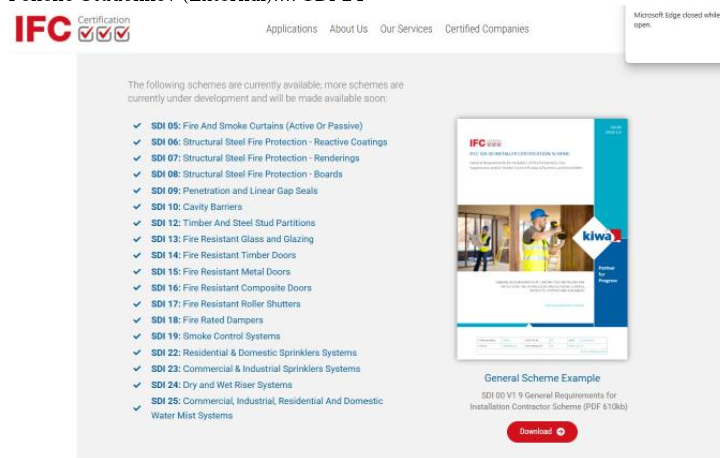
PENCHO STUDENKOV Yeah, SDI24 I think was the only scheme I know for the dry wet risers.
RICHARD FREER This is a training scheme?
PENCHO STUDENKOV Competency, yeah.
RICHARD FREER OK, we haven’t got that.
MATT FORD I think that’s the IFC scheme thing, whereas SP105 is the one that I’m aware of, that’s the BAFE scheme. But there is an IFC scheme as well by the looks of it.
GEORGE STEVENSON Are IFC and BASF two competing organisations?
MATT FORD I think IFC is run by Kiwa who are big consultants in the industry. BAFE is obviously by BAFE and then you’ve got the LPC that offer the sprinkler accreditation 1048 and 1301. I think BASF probably sit separately to all of them as more of an industry body. But the IFC schemes the BAFE schemes and the LPC schemes I guess compete for companies to be accredited to. Obviously you can be accredited to more than one of them.
PENCHO STUDENKOV I just put a screenshot so that you can see all other schemes. So the SDI24 is for dry/wet risers but they pretty much have cover for all of the active and passive fire safety measures.
MATT FORD 22 and 23 are sprinklers so you’ve got resi sprinklers and commercial sprinklers.
GEORGE STEVENSON Can I just ask a question of what Pencho has put up there? So those are the IFC schemes. And my understanding is, because I know that there’s been a lot of discussion about what’s an approved scheme so that you don’t have to notify the Regulator. But to my knowledge there are no approved schemes that would get you around the fact of notification. Is that your understanding as well, Matt?
MATT FORD Yeah, we have to go for Gateway 2 approval on any high-risk building, for instance, and put sprinklers in. Even if the LPC approved, IFC approved, BAFE approved, it doesn’t get you out of that Gateway 2 application for installing sprinklers on a high-risk building.
GEORGE STEVENSON And under what circumstance with repairing something or maintaining them, because there is this discussion about fire doors as to whether you need to notify, which the jury seems to be out on that. How would that fit with sprinklers? Dry risers, you probably wouldn’t need…
MATT FORD On sprinklers we haven’t come across a situation where we’ve had to do a notification on any of the repair or the remedial works that we do typically. I guess if a building was modified to a large degree and you’re extending or changing the coverage of the sprinklers it would. But again, to modify the building itself it probably goes through a Gateway 2 application so it would be wrapped into the same one I would think. But no, on the repair side of things we haven’t come across a situation where it’s been thought that it needs BSR approval.
And I can’t think of many scenarios where it would because you’re effectively replacing like for like mostly. Even if you’re replacing a set of sprinkler pumps you’re taking one out and putting one in, so you’re not really changing a massive amount.
JOHN MORROW I think that’s the same for us, replacing component parts like for like, there was no need for a notification. But I think if you’re making changes that impact or relate to the original approved fire strategy for the building, for the scheme, then that’s something else. But again, that would be a radical change.
GEORGE STEVENSON Is there a relationship between say the sprinkler system and any other systems? Like it would be maybe connected to the fire alarm system.
JOHN MORROW Yes, most definitely, it’s all part of the cause and effect strategy for the scheme and the fire strategy for the scheme.
GEORGE STEVENSON So if you change the fire alarm system…
MATT FORD The way it typically works is if a sprinkler system is connected to the fire alarm it’s effectively an output from the sprinklers to an input on the fire alarms. So if a sprinklers activate, it puts the fire alarm panel into fire and potentially calls the fire brigade or do all of the cause and effect stuff on the fire alarm system. But the systems do work independently other than that, so the sprinklers are the sprinklers and the fire alarm is the fire alarm. I guess if you were changing the coverage of the sprinkler system or the fire alarm system there could be an impact on the other, from a fire strategy point of view.
If you’re changing the type and scale of the fire alarm system it might impact, you might want to improve your sprinkler protection. But on a day to day basis the only interaction between the two system types are if sprinklers activate they will send an alarm signal to the fire alarm. The fire alarm wouldn’t ever go the other way though. You wouldn’t have a fire alarm system setting off the sprinklers, unless it’s a very specific type of sprinklers and called a pre-action system, but that’s probably a little bit esoteric for this.
GEORGE STEVENSON Just for your information this might be a useful thing from your perspective. I was on a panel a couple of weeks ago that Dame Judith was talking at. And she was talking about a particular scheme, I may have conflated this with the student accommodation project that seems to have been canned. But she was saying that the sprinkler system that had been put in, it was only the pump that was used, it could only pump up to floor 13 and it was a 20-floor building. And she said that the person that actually installed the pump was aware of the fact that it wasn’t adequate.
MATT FORD We’ve seen it happen. Certainly in residential sprinklers, because there was a big expansion of the market obviously after Grenfell. And when Wales said every house has got to have sprinklers, I think Scotland have now said that every new build house has got to have sprinklers, it just drew a lot of non-sprinkler companies into the market, effectively plumbers, putting sprinklers in to buildings that were just not in any way qualified to be doing it. And we’re now going round servicing some of this kit and finding its got no chance of meeting its design flow and pressure tests.
You’ve got the wrong type of pumps or even trying to feed of town’s mains supplies that aren’t adequate. So there’s a lot of systems out there that need rectification because they’ve been designed and installed by people that were nowhere near competent. But I think it relates to that big opportunity that people saw that suddenly residential sprinklers became a big topic and everyone dived into the market. So I think a lot of work over the next few years is putting some of that right because we’re still finding systems out there that bear no resemblance to what they should do from a performance point of view.
JOHN MORROW We’ve had schemes come through new business, small redevelopments on areas where the individual dwellings had residential sprinkler systems designed already. But we ascertained early on that there was inadequate water pressure coming to the scheme to let them work effectively. So it’s a big draw, it’s the money, the market is there and it attracts…
MATT FORD Cowboys, let’s say.
JOHN MORROW That’s the truth of it. So as a landlord, that’s something now we have to scrutinise even at the new business stage, even at that stage. We have to say OK, what you’re specifying, your design, is it actually achievable?
MATT FORD And also the need to factor, especially if they’re running of towns main supplies, is over the years as more housing goes in or the area is developed further, that towns main pressure and flow potential drops. A lot of water companies have turned down the pressure in their towns mains to reduce their leakage because it’s an easy way of brining their leakage figures down, certainly in London and places like that. That suddenly a sprinkler system that was meeting its requirements 5 years ago no longer does because the flow and pressure of the towns main is not what it was.
So you’ve got to future proof it as well by assuming that if they build another housing estate down the road they’re going to have less supply. So towns mains, especially in residential world, towns mains supply systems are to be considered very carefully. In commercial sprinklers they’ve pretty much stopped doing towns mains systems. Any new build now is generally pump and tanks or at worst a booster pump. But in resi world there are still a lot of towns main supply systems going in, certainly on small houses, smaller developments that is a risk.
JOHN MORROW That’s what we did. We found on flat and developments we’d insist that, I think it was a Category 4 installation where it’s tanked. So that we know that there is adequate water resource on the site, rather than a reliance on mains pressure.
GEORGE STEVENSON The other thing I was told recently is there is a major problem now with data centres. So for example, Musk has put a data centre in Arizona and it’s taking so much water out of the local community that everybody’s water pressure has just disappeared.
MATT FORD Yeah, it’s the cooling, you’ve got to keep these things cool and they’re all water cooled these days. That’s going to be a big thing as they start building a lot of data centres in the UK I think. The North East is going to be a big area for data centres, so Northumberland water will have to get some bigger pumps I think, some more reservoirs.
GEORGE STEVENSON What I wanted to say is where we’re going with this, what we’re trying to do is take the guidance that we’ve got and turn it into something that’s a bit more consumable. Because we’ve got fantastic detail here, but people haven’t got the time to read things and also there is cross-relationship between them as well. So we’re going to be using some AI over the next few weeks to basically interpret this information. And what we want to do is have the experts here just to make sure that were here just to make sure that we’re not losing stuff that is critical.
The other thing that we want to do is to encourage people that are interested to join us in the Golden Thread Taskforce community to actually do some paid work. So, our logic with this is if we’ve got people who are experts and they know how to solve problems. A lot of people at the moment are experimenting with ChatGPT and coming up with solutions, but they’re not quite sure where to go with that and also how it pulls together with other things. So what we’re trying to do is look at setting up some sort of community where people can come to it with an idea and tie into it people that have got AI expertise to actually turn that into something that is coming up with a joined up solution.
So if you’re interested in joining that next stage in taking the guidance and turning it into something that is more automated, then please put ‘next stage’ in the chat. The other thing that we’re doing is we’re looking at this from a point of view of creating some agents or roles. Because what we’re thinking is that if we’ve got, like John was saying he’s got a compliance team within his organisation, but he’s also got a repairs team. And there’s obviously the development team and there’s various different groups, all of which need different information for different purposes. So our vision with this is to get those different roles created as agents which can then look at all of this complex data and identify where the weaknesses are. Or make the connections that you wouldn’t normally be able to do.
The experts will be able to do, but we’re losing people from the industry that have got that expertise. So if we can train some technology to be able to support people that’s what we want to do. So how we fund the work is the next stage in the process. But we think if we can bring together the community and then we’ve got people that understand what the problem is, have got some ideas as to how the problems can be solved, these are all mini exercises, and then we can glue those together. So if you’re interested then put ‘next stage’ and we’ll have that conversation.
RICHARD FREER And anyone who has put ‘next stage’ in the chat will quite possibly get a message about having a quick 15-minute chat to get a better steer on that.
CHAT
Alex Oldman (Unverified)…. Golden Threat Taskforce please - check I am signed up with my new email address alex.oldman@totalmobile.co.uk
John Morrow (External)…. We have them and it does lead to some confusion in regards maintenance and up keep, more to the point who is responsible
Gordon Pringle (External)… Crossing London on the tube but listening intently where possible. Sorry Lost comms
Pencho Studenkov (External)… ((A label or notice should be attached or fixed adjacent to or on the sprinkler riser next to the main sprinkler stop valve as a permanent record of a system’s design data )
David Poat (External)…. George Stevenson - in the past we've talked about using the BIM4Hsg community to develop a standard client reg 38 requirement so that we can all be approaching our contractors and asking the same question - any thoughts about how we can collaborate and pull this together ?
Pencho Studenkov (External)…. SDI 24
Academic Summary - Group A Roundtable BIM4Housing (25-09-2025)
Key Discussion Points
- Golden Thread Initiative: Government-backed effort to define essential asset and survey information; involves collaboration among developers, clients, and manufacturers (George Stevenson).
- Standard Methodology: 12 asset types examined with questions on risk mitigation, maintenance, required information, competence levels, and product change management.
- Updates & Extensions: Guidance documents for fire doors, dampers, fire stopping, and cavity barriers refreshed in 2023 and extended to inspection/maintenance standards (e.g., NHS fire doors).
- Systemic Approach: Emphasis on how fire safety assets interact as a whole (e.g., compartmentation, fire doors, seals, smoke control). Federation of separate golden threads needed for holistic safety records.
- Regulation 38: Legal requirement for fire & emergency files often not fully met. Industry must raise standards and ensure information quality for asset management.
- Community Collaboration: Taskforce of 100+ participants working to simplify and standardize asset information; aim to federate systems and software interoperability.
- Poll on Asset Information: Queries on industry compliance in capturing asset references, classification, location data, fire strategy relevance, certification/test data, O&M records, and competency evidence.
- Sprinkler Systems: Discussion led by Matt Ford (sprinkler specialist) highlighted differences between residential and commercial standards (BS 9251 vs BS EN 12845). Call for more balance in guidance documentation.
- Commissioning Certificates: Debate on whether design duty, actual flow/pressure test results, and hydraulic test data should be explicitly included.
- System Data Labels: Identified need for physical labels on valves and pumps for traceability.
- Maintenance Challenges: Industry gaps in updating as-built drawings, managing O&M manuals, and recording changes across building lifecycle (Matt Ford, John Morrow).
- Competence & Supervision: Concerns raised about schemes (BM Trada, BAFE, IFC) accrediting companies rather than individuals; questions on supervision ratios.
- Standards Evolution: Transition from LPS1301 (residential) into LPS1048 (broader accreditation). New requirements expected to improve competence and broaden coverage.
- Dry/Wet Risers: Importance of O&M manuals, commissioning certificates with hydraulic results, pressure testing, and explicit inclusion of air release valve locations (Matt Ford, Pencho Studenkov).
- Integration & Dependencies: Sprinklers and alarms interact as part of cause-and-effect strategies, but remain largely independent systems (Matt Ford, John Morrow).
- Future Risks: Residential sprinkler market expansion post-Grenfell has attracted inexperienced installers (‘cowboys’), leading to underperforming systems (Matt Ford, John Morrow).
- Client Responsibility: Clients must ensure Regulation 38 compliance at handover and throughout lifecycle, not rely solely on contractors (John Morrow).
- Next Stage: BIM4Housing aims to use AI to integrate guidance into consumable, role-based outputs, and form a community for problem-solving and automation (George Stevenson).
Key Risks & Action Points - Group A Roundtable BIM4Housing (25-09-2025)
Key Risks Identified
- Incomplete compliance with Regulation 38 fire & emergency file obligations.
- Loss or inaccuracy of as-built drawings and O&M manuals, leading to poor lifecycle records.
- Over-reliance on contractors for record keeping without sufficient client oversight.
- Use of unqualified or inexperienced contractors for residential sprinklers (‘cowboy’ installations).
- Incompatibility of mastics or materials causing long-term leaks in systems.
- Weak supervision ratios in accreditation schemes (e.g., BM Trada allowing one supervisor for 20 operatives).
- Lack of federated golden thread information across multiple systems and platforms.
- Inadequate integration of commissioning certificates (flow/pressure data often missing).
- Risk of towns mains pressure drops affecting long-term sprinkler system performance.
- Data centre water usage impacting local community water pressure (future emerging risk).
Action Points
- Develop clearer, federated asset information systems linking location, specification, and fire strategy.
- Ensure commissioning certificates explicitly capture design duty, flow rates, and hydraulic test results.
- Mandate physical system data labels on key components (valves, pumps).
- Strengthen client accountability at handover and throughout lifecycle for Regulation 38 compliance.
- Promote industry adoption of digital, machine-readable asset records (XYZ coordinates).
- Update sprinkler guidance to distinguish residential (BS 9251) from commercial (BS EN 12845) requirements.
- Encourage competency-based accreditation schemes that focus on individuals, not just companies.
- Adopt best practice hydraulic pressure testing (e.g., 1.5x operating pressure for risers).
- Integrate O&M manuals into all guidance documents, ensuring comprehensive lifecycle information.
- Support AI-enabled initiatives to automate asset data integration and provide role-based outputs.
- Encourage proactive collaboration through the Golden Thread Taskforce community.